Er worden via enkele grote reisorganisaties ook verzorgde reizen naar Schotland aangeboden,
waarbij daguitstapjes naar deze eilanden in het programma zijn opgenomen.
Deze verzorgde
reizen gaan van geheel verzorgd (reis, overnachtingen, maaltijden, programma) tot gedeeltelijk
verzorgd (reis en onderkomen).
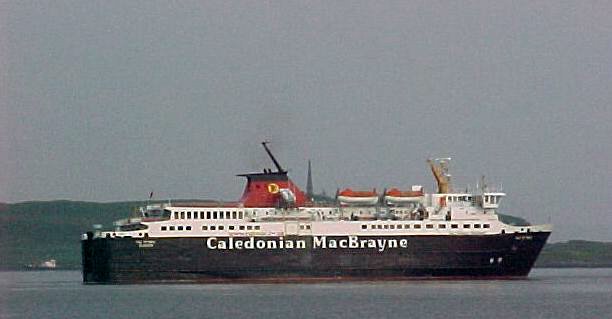
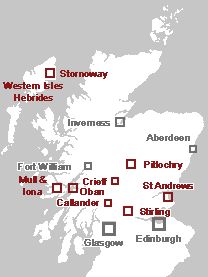
Bij een individueel bezoek aan deze eilanden kunt u vanuit Oban
(Schotland) deze eilanden gemakkelijk en in korte tijd met een veerboot bereiken.
Het Schotse eiland Isle of Mull heeft een oppervlakte van 909 km2 en is het
grootste eiland van de Binnen-Hebriden. Het eiland is gescheiden van het vasteland door
de 'Sound of Mull' en de 'Firth of Lorn'.
Het eiland is bergachtig en er wonen nog geen 3000 mensen.
De hoogste berg is Ben More (966m). Mull heeft veel tuinen, boerderijen,
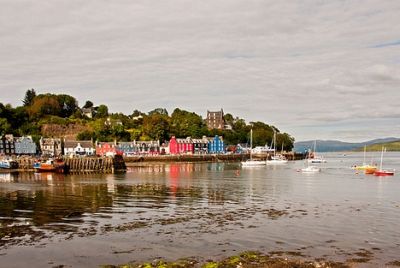
kastelen en landhuizen. De hoofdstad is Tobermory.
Het Isle of Mull is in meerdere films gebruikt vanwege de prachtige omgeving. Zo is het
allereerst mogelijk om het eiland te zien in de Entrapment, Highlander en Endgame.
Daarnaast gaat het in de kinderserie op BBC Balamory over de stad Tobermory.
Zo kunt u gemakkelijk eens kennismaken met de prachtige landschappen op het eiland,
om er vervolgens zelf een kijkje te gaan nemen.
 Het eiland Isle of Iona is slechts 5,6 km lang en 2,4 km breed en behoort tot de
Binnen-Hebriden. Het eilandje is van het eiland Isle of Mull gescheiden door de
'Sound of Iona'.
Het eiland is bergachtig en heeft stranden.
Vanwege de grootte zou je Isle of Iona de kleine zus van grote broer Isle of Mull kunnen noemen.
Het eiland Isle of Iona is slechts 5,6 km lang en 2,4 km breed en behoort tot de
Binnen-Hebriden. Het eilandje is van het eiland Isle of Mull gescheiden door de
'Sound of Iona'.
Het eiland is bergachtig en heeft stranden.
Vanwege de grootte zou je Isle of Iona de kleine zus van grote broer Isle of Mull kunnen noemen.
Landbouw, schapen en visserij zijn bestaansmiddelen maar toerisme is de belangrijkste
inkomstenbron voor de bewoners.
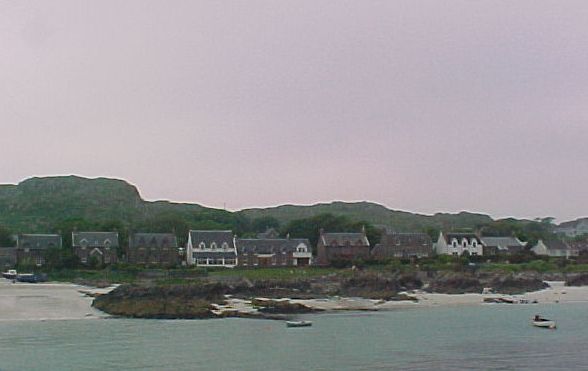
Isle of Iona is met 175 inwoners een zeer kleinschalig en daarmee sfeervol eiland.
De verschillende faciliteiten zijn eigenlijk allemaal in St Ronan's Bay te vinden, een stadje, dat
u aan de oostkant van het eiland vindt. Hier vindt u bijvoorbeeld de school, het postkantoor
en ook de twee hotels die het eiland kent. Aan de andere kant kunt u ook een bezoek brengen
aan Port Bàn, dat zich aan de westelijke kant van het eiland bevindt. Hier kan men
genieten van het geweldige uitzicht.
Het eiland is beroemd om haar geschiedenis op het gebied van Keltisch Christendom.
St. Columba kwam in 563 met enkele getrouwen op het eiland aan vanuit Ierland.
Zij stichtten er een klooster, dat door de Denen werd platgebrand in de achtste of negende eeuw.
Iona was bischopszetel van 838 tot 1098. In 1203 werd er een klooster van de Benediktijnen
gesticht, waarvan nog resten te zien zijn. De cathedraal is uit de dertiende eeuw.
Het kerkhof van St. Oran's Church heeft graven van veel Schotse, Ierse, Noorse en Franse koningen.
Veel historische plekken werden gerestaureerd en tonen een prachtig beeld van het oude Iona.
Het actuele reisaanbod staat boven aan de pagina.
 Copyright foto: Partan Man